85% of Europeans believe that climate action should be a priority for the European Union. Among young people, one third considers that the environment and climate change should be a priority for the Union. It is therefore striking to observe the outcome of the last European elections, in which the green party bloc lost almost a third of its seats. In countries like Germany, it is estimated that only 11% of the youth vote went to parties of green ideology. The reason behind this paradox is more subtle than it appears: for Generation Z, concern for the climate is a shared value, but it is not the axis that defines their political identity.
Food first, everything else later
The Youth Survey 2024, cited above, reveals that young people consider the environment and climate change to be the second priority for the EU, after the rising cost of living, which accounts for 40% of responses. However, in practice, the 2024 post-electoral Eurobarometer reveals that, when it comes to voting, the 15–24 age group casts their ballots driven by other concerns.
32% of respondents report having considered the environment when casting their vote, which is consistent with the Youth Survey. However, the cost of living and the economic situation weighed more heavily at the ballot box than the climate emergency.
This picture looks very different from 2019, when climate change was the most motivating factor for voters under 25, shaping 45% of their vote. The data allows us to draw two conclusions: on the one hand, the 25–39 age group shows an equal or greater commitment to the environment and, on the other, this was not always the case.
The Russian invasion of Ukraine and the COVID pandemic have completely transformed the macroeconomic landscape. The average annualised inflation rate rose from 0.9% in the 2014–2019 period to 3.9% in the 2019–2024 period. The 15–29 age group has been particularly vulnerable to this phenomenon due to its higher prevalence of temporary employment (31.1% versus the EU average of 11%), its greater risk of poverty or social exclusion (24.1% versus 21%) and its higher share of low-wage occupations (25.2% versus 12.1% and 13.4% among workers aged 30–49 and over 50, respectively). Rising prices in sectors directly relevant to young people such as education services, food (up 33.2% between 2016 and 2025) and housing therefore hit this group the hardest. This situation is particularly telling when it comes to understanding the shift in young voters concerns: in Croatia, Slovakia, Italy, Spain, Poland, Greece and Ireland, more than 80% of people aged 16 to 29 live with their parents or remain financially dependent on the family home, and the average age of leaving the parental household across the EU stands at 26.9 years.
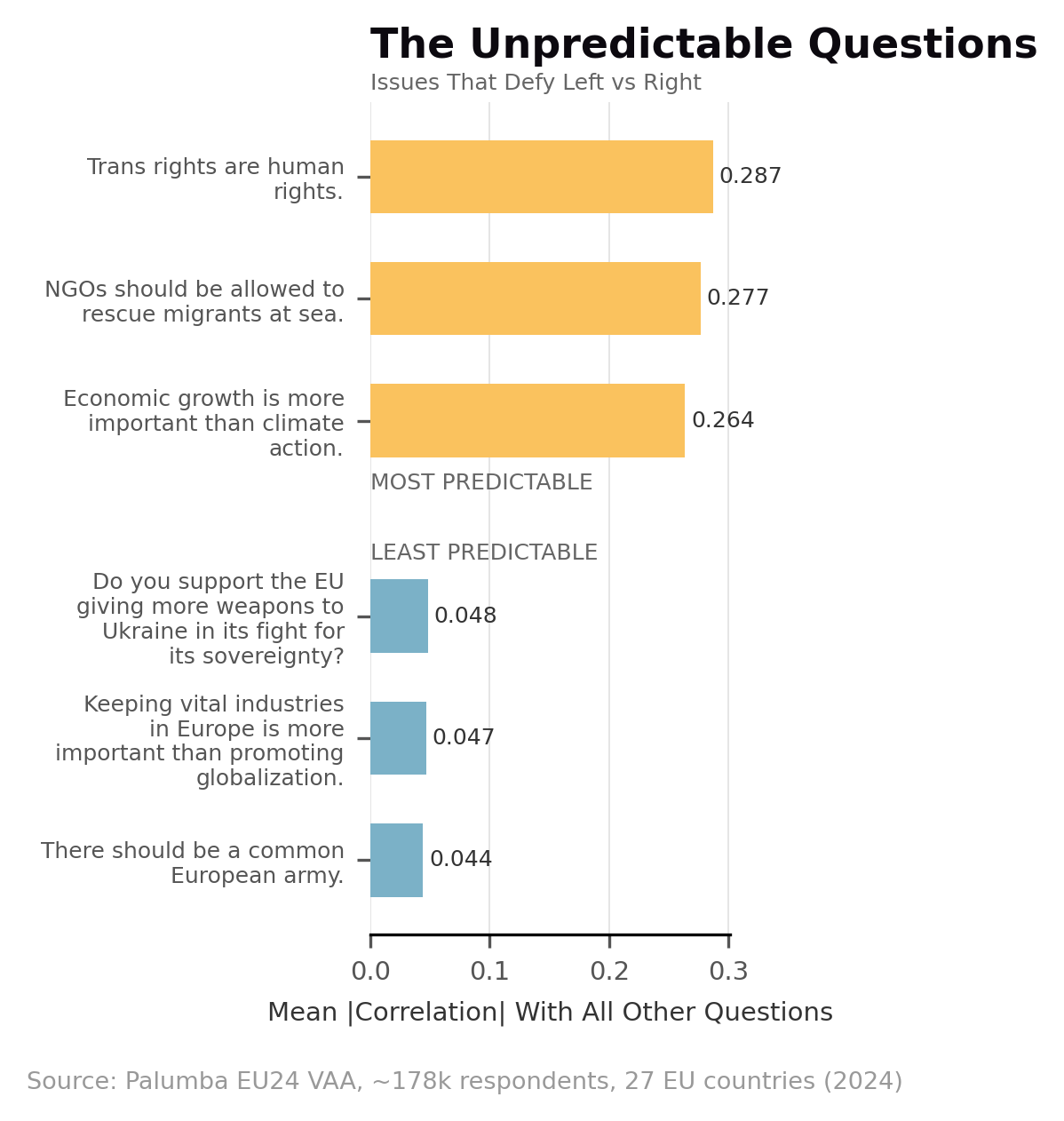
Data provided by Palumba shows that only one quarter of young people believe that economic growth should take precedence over climate action. This may seem contradictory to everything set out in this section, but it may also be part of the explanation. Although young people’s values place the environmental concerns above economic development, when voters approach the ballot box, they prioritise being able to move out and live comfortably over something that, at an individual level, feels abstract and noble such as protecting the environment.
Divide and unconquer
“Young people are turning right” is a mantra that is constantly repeated, but this trend reflects no more than one dimension of the true change in youth electoral behaviour. In the 2024 European elections, 33% of young French voters chose the radical left party “La France Insoumise” compared to 30% for the far right and 5% for the traditional left. Something similar occurs in Italy. Despite Giorgia Meloni’s Fratelli d’Italia winning the national election with 28.75% of the vote, the party attracted only 16.6% among 18–27-year-olds. More than 60% of Italian Gen Z voted for centre-left parties with the Democratic Party obtaining 23.3% and the Greens–far Left Alliance a further 12.9% among this age group. While it is true that the far right has expanded its social base among young people in the majority of European countries such as Germany (where the AfD tripled its vote share among 18–24-year-olds) or Spain (two in ten young Spanish voters voted for the far right), it cannot be argued that this is a uniform trend across the continent, one that differs from a generalised tendency affecting the population as a whole regardless of age, and that what is gaining ground in sum are extremist ideas, both on the left and the right.
This trend towards the extremes creates a double crowding out effect on the green vote. On one hand, right-leaning young people who previously supported the EPP (the traditional centre right), a party that does back the Green Deal, now reject climate policies. The EPP, under electoral pressure, has progressively shifted towards a more sceptical stance on climate policy. Knowing that a young person leans right, there is a very high probability with a correlation of 0.264 that they will prioritise economic growth over climate action. For right-leaning young people, concern for the climate has thus ceased to be a generational priority and become instead a phenomenon associated with a different ideological tradition.
The second crowding out effect is reflected in the pressure that polarisation exerts on green parties. As one-issue parties whose identity revolves exclusively around the climate agenda, they are the most vulnerable to the fragmentation of the youth vote. When that vote migrates towards the extremes, climate does not disappear as a concern, but it does disappear as a parliamentary priority: the parties that capture those votes carry agendas where the environment competes with immigration, economic redistribution, or anti-establishment sentiment. It may even be the case that voters with climate concerns choose to vote for a social democratic party over a green one in order to push back against the anti-climate agenda. The result is a qualitative dilution of climate ambition not because nobody defends it, but because nobody defends it exclusively anymore.
In short, young voters concern for the environment does not vanish at the ballot box it splits and dilutes under the pressure of polarisation. Climate concern has ceased to be a cross-cutting value of Generation Z and has become instead a matter of ideological branding: right-leaning young people abandon it as a priority, while left-leaning ones subordinate it to other agendas within their bloc. The result is not indifference, but fragmentation.
The green-urn paradox answer
In the last European elections, there was one clear winner among Generation Z: abstention. Only 36% of young people aged 15 to 24 voted, a six-point drop from 2019. Of those who stayed home, 15% said they could not find a candidate who represented their views; another 15% cited distrust in politics. Moreover, although 20% of the European population is aged between 18 and 35, only 6% of MEPs belong to that age group. The democratic and electoral results cannot therefore be taken as a reliable reflection of how much weight young people give to the climate cause they reflect, instead, what the political context allows them to express.
The green-urn paradox is not the product of hypocrisy or indifference on the part of Generation Z towards the climate crisis. It is the result of three simultaneous pressures: the material urgency that displaces climate as a priority at the moment of voting, the political polarisation that transforms it from a cross-cutting value into an ideological brand, and a system of representation that systematically underweights the voice of those with the most at stake. Young Europeans are green at heart. They simply stopped believing that the street and the ballot box led to the same place. Until they do, the urn will remain green, and empty.


